The wolf’s apparition
Three Bags FullThe wolf’s apparition is a frightening presence reported in the wild hills beyond the meadow, and its significance lies in the story’s refusal to make it identical with Melmoth. The flock fears it as a possible supernatural danger; an unnamed lamb insists that what he saw was real and unlike the shaggy ram who later returns. Melmoth offers an explanation for the hoofprint mystery, but he also leaves open the possibility that George was not accompanied by only one presence on the night he died. The apparition therefore persists at the boundary between an identifiable shape and an unresolved story.
First Reports and the Flock’s Fear
The apparition enters the flock’s understanding through talk of the Devil’s hounds and the danger surrounding a shepherd who leaves his sheep. Lane wonders whether the apparition might actually have been one of those hounds. That suggestion does not calm the flock: although the meadow is sunny, fear spreads through the sheep, who instinctively press closer together, while Cloud bleats anxiously. The scene makes the apparition’s power collective as well as individual. Before the flock knows what it is, the possibility of it changes how the sheep occupy their familiar pasture.
Maude tries to reduce the threat by reasoning that the Devil’s hounds need not be large: human souls, she suggests, are so small that even a little dog could deal with them. The sheep recall a tiny, golden-coated dog carried by a tourist and briefly consider whether the supernatural danger might be no larger than that. This imagined golden shape becomes important because the unnamed lamb knows that the apparition he saw was not golden. The contrast reveals that the flock’s tentative explanation has begun to replace the witness’s experience with a safer, more manageable image.
The Lamb’s Memory
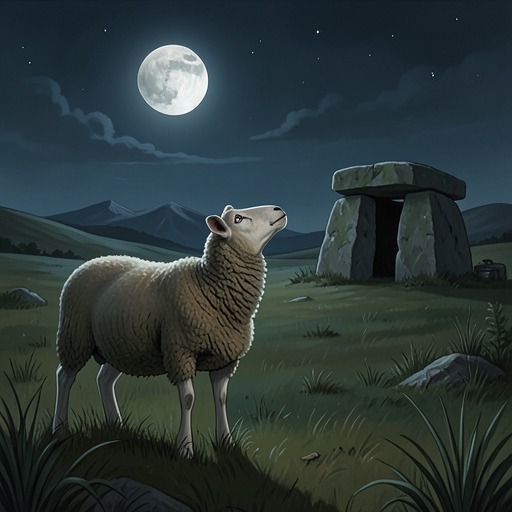
The lamb has heard the older sheep’s conversation while sheltered in Cloud’s fleece. He wants to challenge Miss Maple’s mistaken conclusion, but he doubts that the experienced sheep would believe or even listen to him. His silence is not a lack of conviction: he remembers the apparition as shaggy and gray, still hunting through the wild hills beyond the meadow. The account ties that memory to a precise time of heightened perception, when the moon has risen but the sky has not yet grown pale and everything gives off its deepest scent. The lamb describes the presence as something felt in the darkness, even with the eyes closed.
His remembered image includes black wings spread on the dolmen and a hoarse cry heard for the second time. These details make the apparition more than a vague fear or a rumor passed among the sheep. Yet the lamb cannot turn his memory into proof that will settle the matter for the flock. Around him, the sheep graze peacefully, and that calm sits uneasily beside his private certainty. The apparition remains active in the lamb’s awareness even when the meadow appears safe.
Melmoth and the Unresolved Identity
When Melmoth returns, his shaggy shape, glowing eyes, fluid movements, and the Crows on his back give Miss Maple a way to understand the hoofprint that had puzzled her. She pictures Melmoth moving through the darkness with the birds on him and identifies the figure she had imagined as the wolf’s apparition. The flock, however, does not find the recognition entirely reassuring. It must reconsider both its fear of the apparition and its fear of Melmoth, without knowing whether either should diminish in light of the other.
The lamb approaches Melmoth and insists, in effect, on a distinction: he has seen the apparition, but it was not like Melmoth and was frightening. Melmoth does not simply dismiss the testimony. He accepts that the lamb saw what he says he saw, while noting that he himself was with George that night and cannot know whether he was the only presence there. His account places George’s death among a series of unexplained figures and events: pale ones in the village, a red woman, silent black ones at the shepherd’s caravan, and carrion eaters falling from the sky. This does not establish what the apparition was; it broadens the night around George’s body into a world of possible witnesses and presences.
Stories, Evidence, and Significance
Melmoth treats the lamb’s story as worth keeping, naming the wolf’s apparition alongside other beings from the flock’s lore. His response validates the lamb’s attention without supplying a final explanation. He also describes ghosts as part of the world the sheep inhabit, but his confidence in stories does not identify this particular figure beyond doubt. The lamb’s direct sensory memory, Maple’s interpretation of the hoofprint, and Melmoth’s insistence that he may not have been alone remain related but not interchangeable kinds of knowledge.
After the exchange, Melmoth turns away and disappears into the gorse hedge. The flock is left with the impression that it may have dreamed his strange return, while the lamb’s earlier memory of the apparition remains undiminished. That ending preserves the uncertainty at the heart of the character: Melmoth may explain the shape and trace that prompted Maple’s recognition, but the lamb maintains that the frightening gray presence was different. The apparition’s narrative force comes from that unresolved gap between what the flock can infer and what one witness remembers.